
How Many Restrooms Does a Race Actually Need?
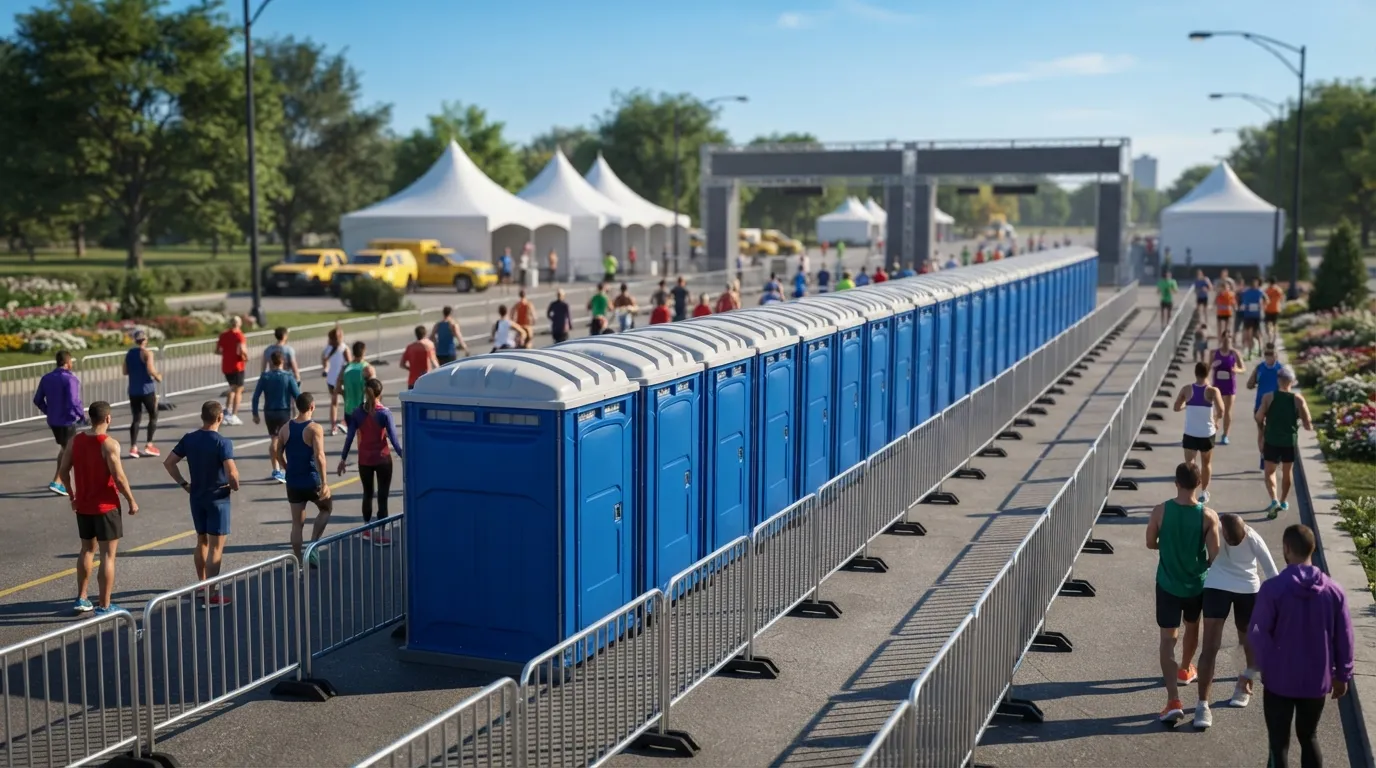
Start with the corral, not the course. A marathon with 800 registered runners standing around before the gun needs restrooms clustered near the staging area, because that's when the line forms, not during the race itself. How many porta potties do I need walks through the ratio math, but the short version: figure one standard portable toilet per 100 runners at the start, then add units at each aid station based on how long people linger there.
OSHA 1926.51(c)(1) sets construction-site ratios (one toilet per 20 workers, scaling up from there), which is a useful reference point even though a road race isn't a construction site. Race organizers in Brockton tend to apply a similar density near the start and finish, then thin it out on the course itself. If your race draws a wheelchair division or a lot of walkers, ADA Standards section 213.2 requires that at least 5 percent of clustered single-user units be accessible, with a minimum of one. Our ADA accessible porta potty units meet that standard, with ADA Standards section 404.2.3 requiring a 32 inch clear door opening and section 304.3.1 calling for a 60 inch turning circle inside.
Finish line crowding is its own problem. Runners finish over a longer window than they start, so finish-area units get steadier use for hours instead of one sharp spike. Budget accordingly and check porta potty placement guide for how to space units along a finish chute without blocking sightlines.
What Does a Marathon Restroom Rental Cost in Brockton?
A standard unit rented for a single event day runs in the range shown below, and pricing depends heavily on how many units you need delivered to one site versus spread across a course.
| unit | duration | typical price |
|---|---|---|
| standard | event | $400 |
| ada | day | $230 |
| deluxe | day | $300 |
| trailer | event | $3500 |
Multi-unit discounts and delivery fees change the math fast once you're ordering for a 5K versus a full marathon with aid stations every two miles. Porta potty rental cost breaks down the full pricing picture, and porta potty rental per day covers single-day logic if you're only closing one road segment. For races that want something nicer at the finish line for VIPs or sponsors, a deluxe flushable porta potty or a small restroom trailer rental handles that without crowding the standard units meant for the general field.
If your event needs generator power for timing equipment, lighting, or a sound system near the finish, that's where a temporary power pole comes in. How to brace a temporary power pole matters here: poles get set in a stable base, guyed or braced against wind and foot traffic, and kept clear of the runner corridor so nobody clips a line at mile 24 in the dark. Pair that with a light tower rental if your race starts before sunrise, which a lot of Brockton marathons do to beat summer heat.
Do I Need Handwashing Stations at a Race?
Yes, plan on at least one handwashing station per restroom cluster, especially near aid stations where volunteers are handling food and cups. 29 CFR 1910.141(d)(2) requires washing facilities to have soap and towels or a hand-drying device, and hand sanitizer alone doesn't satisfy that. Our handwashing station rental units cover start, finish, and mid-course stops, and a portable sink rental works well for volunteer tents handling food service. If you'd rather keep it simple at smaller water stops, a hand sanitizer station rental is a reasonable supplement, just not a substitute where OSHA 1926.51(a)(1) potable water requirements are already in play for volunteer hydration points.
Brockton races that close streets or use municipal parks should also plan for crowd control. Crowd control barrier rental and temporary fence rental keep spectators off the course near restroom clusters, which matters most at the finish line crush. Nearby communities running similar events, like Stoughton about 5.8 miles northwest or Bridgewater Town roughly 8.7 miles south, deal with the same start-finish density problem, so the same layout logic applies across the region.
How far in advance should I book race restrooms?
Book as early as your permit allows, ideally 60 to 90 days out for a marathon-sized field. Units, generators, and fencing all draw from the same limited inventory during peak race season, and popular weekend dates in Brockton fill fast. Use request a quote to lock in numbers early.
Can I get restrooms delivered along a course, not just at the start?
Yes. Delivery to multiple aid stations along a route is standard for marathons. Confirm truck access at each stop, since a roll-off or trailer delivery needs about 60 feet of straight clearance behind the vehicle, though most portable toilet drops need far less room.
What size unit works best for a finish line area?
A standard unit works for most finish areas, but consider a restroom trailer rental or 4 stall restroom trailer if you expect a long finish window with steady traffic for several hours rather than one quick surge.
Do I need a permit to place restrooms on city streets?
Placement in the public right of way needs confirming with the city. Check porta potty permit requirements before finalizing your course map, since street closures and restroom placement often get reviewed together.
Are accessible units required for a public race?
If your race is open to the public, plan on ADA-compliant units per ADA Standards section 213.2. See ADA restroom requirements for full detail on clearances, including the 36 inch route width under section 403.5.1.
Next step
Get a delivery date
Tell us the address, the dates and the headcount. We size the order and confirm the route.